Saturday, October 11, 2014

Sports Nutrition Supplements: What They Have To Offer

         
Supplements are becoming more popular among workout enthusiasts and athletes all around the world. The sport supplement relates to performance which contains different types of substances, nutrients, proteins, vitamins, fats, carbohydrates among many others.

Performance enhancing products help the athlete in many ways including: building strength, power and muscle, increase brain function, enhance recovery & endurance, improve anaerobic capacity among many others.

The nutritional supplement industry is big business, but that doesn't mean that you need to spend big bucks for protein powders, health shakes, muscle formulas, and nutrition bars. Again, you can get a wide variety of high quality, brand name products at the same place you get your vitamins.

Workout supplements are a specialized branch of nutrition that is exclusively formulated to cater to the varied nutritional requirements of athletes. The performance of an athlete is based on a combination of complex factors like nutritional intake, physical fitness, training and certain amount of natural talent.
Nutritional supplements plays an important role in the promotion of the athlete's success by helping them to optimally fuel themselves and stay healthy so that they can improve their fitness level.


Protein Powders
Which protein powder is the best?  Well, whey protein seems to the most popular, which is derived from milk.  It has the best bio availability and to be honest tastes the best of all the protein powders. Egg protein powder is also good, but it's actually more expensive and doesn't mix as well as whey powder.Whey protein mixes the best and can be added to water, juice, milk, or other liquid-with surprising delicious results. As a food ingredient, whey powders are easily mixed or dissolved into a formulated food like oatmeal.

Getting the proper amount of protein in your diet to repair and build muscle after a workout or competition can be very demanding. It requires a lot of time to cook and prepare high protein foods like chicken and turkey. The best way to get all of your protein is to supplement with protein powders. Protein powders are extremely high in protein and they are very convenient to use.

Protein powders such as casein, whey, egg, rice and soy are processed and manufactured sources of protein. These protein powders may provide an additional source of protein for athletes. The type of protein is important in terms of its influence on protein metabolic response and possibly on the muscle's exercise performance. The different physical and/or chemical properties within the various types of protein may affect the rate of protein digestion. As a result, the amino acid availability and the accumulation of tissue protein is altered because of the various protein metabolic responses.

Casein Protein is the primary protein found in cows milk.  It comprises 80 percent of milk protein.
While whey protein digests super fast, casein protein is the slowest digesting protein on the market. Studies have demonstrated that casein protein can sustain the body with a regular supply of amino acids for at least seven hours, making casein the most anabolic protein, even more than whey. The rationale behind this is really because casein forms a "gel" in acidic environments like the stomach, and so releases a steady supply of amino acids into the bloodstream, permitting your body to remain anabolic.

Casein Protein is effective way to grow larger muscles and also to keep body healthy. This protein is different from the regular protein. Sometimes it is required to slowly liberate the protein nutrients into the body instead doing all at once. Night is considered as the best time to take this protein. The main reason to consume is to minimize the time of digesting protein while the body is working. If the casein protein is taken at night after working out then the body can take ample of time to release it and regenerates the muscles in the night as well in the day. The body make advantage of the slow time release of this protein.

Thursday, August 7, 2014

The Paleo Diet: The Rationale

http://www.barnesandnoble.com/w/paleo-smoothies-john-matonis/1120052618?ean=2940149647538&itm=1&usri=2940149647538

The diet is based on several premises: 

  • One of which is that human ancestors evolved for thousands of years and became well-adapted to foods of the Paleolithic era. 
  • Advocates argue that food cultivation and preparation greatly declined in quality about 10,000 years ago, with the advent of agriculture and domestication of animals and that humans have not evolved to properly digest new foods such as grain, legumes, and dairy, much less the highly-processed and high-calorie processed foods that are so readily available and cheap.
  • This has led to many of our modern-day problems such as obesity, heart disease, and diabetes.


Advocates claim that followers of the diet may enjoy a longer, healthier, more active life.

Human physiology has changed little since the time our ancestors were hunter-gathers. Modern humans are adapted to the diet or diets of the Paleolithic period. The dawn of agriculture and industrialization has led to the availability of foods for which we are not evolutionary adapted. It is possible to understand the ancient diet and reproduce it in modern times, and to learn from contemporary hunter-gatherers.

The Modern Day Paleolithic Diet 

No dairy food -- Very little cereal grains --Food was not salted -- Lean meat was eaten.

More Protein

Meat, seafood, and other animal products represent the staple foods of modern-day Paleo diets, since advocates claim protein comprises 19-35% of the calories in hunter-gatherer diets.The Centers for Disease Control and Prevention, the national public health institute of the United States, recommends that 10-35% of calories come from protein.

Fewer Carbohydrates

The diet recommends the consumption of non-starchy fresh fruits and vegetables to provide 35-45 % daily calories and be the main source of carbohydrates. According to the United States Department of Agriculture, the acceptable macronutrient distribution range for carbohydrates is 45 to 65 percent of total calories. A typical modern diet gets a lot of carbohydrates from dairy products and grains, but these are excluded in the Paleolithic diet.

Seeds such as walnuts are rich sources of protein and micronutrients.

High Fiber - High fiber intake not via grains, but via non-starchy vegetables and fruits.

More Fat - Advocates recommend, relative to modern diets, that the Paleolithic diet have moderate to higher fat intake dominated by monounsaturated and polyunsaturated fats and omega-3 fats, but avoiding trans fats, and omega-6 fats since saturated fats are considered to have little or no adverse effects upon cardiovascular disease risk.

Less Salt - It is well known that modern diets are high in salt and many diets, including the Paleolithic, recommend a reduction.


Balanced Alkaline vs. Acid

Any food presents either a net acid (e.g. meats, fish, grains, legumes, cheese, and salt) or alkaline (e.g. fruits and vegetables) load to the kidneys.A good diet strikes a balance.

More Micronutrients

A higher intake of vitamins and minerals is recommended via grass-fed meats, fruits, and vegetables rather than grains.

Energy Density

The Paleolithic diet has lower energy density than the typical diet consumed by modern humans.This is especially true in primarily plant-based/vegetarian versions of the diet, but it still holds if substantial amounts of meat are included. For example, most fruits and berries contain 0.4–0.8 calories per gram, and vegetables can be even lower than that (cucumbers contain only 0.16 calories per gram). Game meat, such as cooked wild rabbit, is more energy-dense (up to 1.7 calories per gram), but it does not constitute the bulk of the diet by mass or volume at the recommended plant/animal ratios, and it does not reach the caloric densities of many processed foods commonly consumed by modern humans: most McDonald's sandwiches such as the Big Mac average 9 calories per gram, since there is a high fat content and fat yields 9 cal/gram. and sweets such as cookies and chocolate bars commonly exceed 4 calories per gram.

Diets with a low caloric density tend to provide a greater feeling of satiety at the same energy intake, and they have been shown effective at achieving weight loss in overweight individuals without explicit caloric restrictions.

Even some authors who may appear otherwise critical of the Paleolithic diet have argued that the high energy density of modern diets, as compared to ancestral or primate diets, contributes to the incidence of diseases of affluence in the industrial world.

Thursday, April 10, 2014

Paleo Smoothies:Recommended Daily Amounts of Fruits and Veggies in a Single Serving

In my opinion the Paleo diet is so popular because of the large amount of fruits and vegetables you eat compared to most diets. We all know they pack a serious amount of vitamin and mineral punch - but getting past the bitter taste can be a challenge.

Many of us shy away from eating a wide variety of greens for one simple reason they taste bitter. The green smoothie to the rescue. To curb the bitterness of leafy greens you add naturally sweet fruit.

Fruit is the "natural sweetener” that helps the medicine of the greens go down easier. But, fruit is high in sugar. And, for that reason, you may want to use only enough to make the green smoothie taste good.

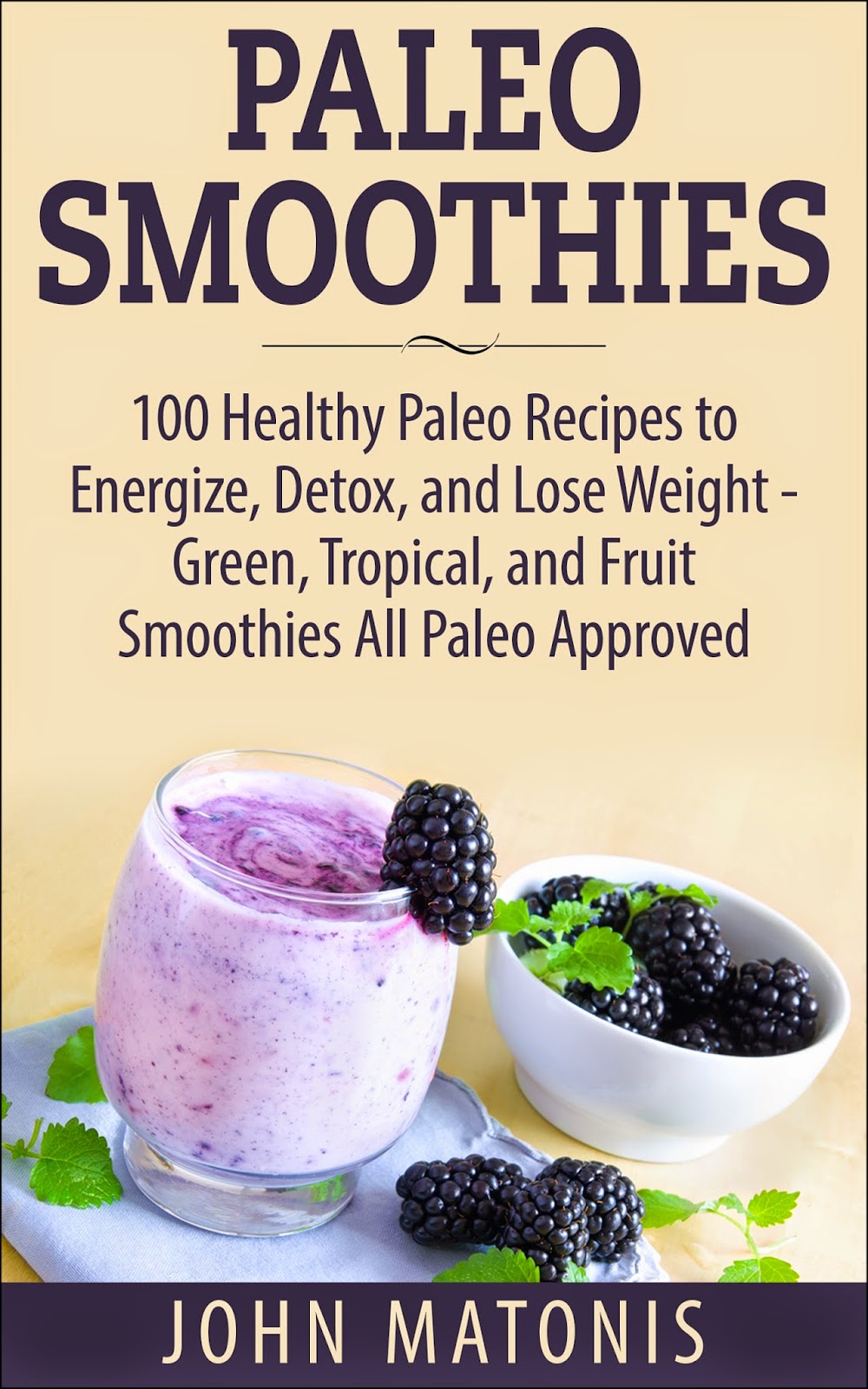
This book has 100 "carefully chosen" smoothie recipes, besides green smoothies the book includes breakfast smoothies, alkaline smoothies, detox smoothies, and low calorie smoothies. 

All recipes are formulated within the strict Paleo guidelines of no grains,dairy, or processed foods. A short description before each category will dial you in on the different types.

Paleo Smoothies:100 Healthy Paleo Smoothie Recipes for Detoxing, Alkalizing & Weight Loss: Boost Metabolism and Turn On Your Fat Burning Machine

Paleo eating consists of all-natural, unprocessed, gluten-free, low glycemic, dairy-free foods. It's the way humans used to eat.

For many who are eating a Paleo diet, with no grains, gluten, dairy, or legumes, cooking meals on a daily basis is difficult and time consuming. Well, it just got a little easier with the Paleo Smoothie Book.

This book will show you how you can enjoy the phenomenal health benefits associated with the Paleo diet, and combine it with the convenience of your blender or food processor.

The blender and the Paleo diet are a perfect pairing for modern, busy people who want to eat right, but don't have the time to prepare meals.

The recipe book not only provides simple, clear instruction and time-saving techniques, but information on nutrition and health benefits of the many ingredients used in smoothies.

It is a recipe collection appropriate for seasoned and beginning cooks, housewives, bachelors, and newcomers to the Paleo and Gluten-free diets.

Let's be real, prepping and cooking meals, as well as cleaning all the pots and pans, can take a lot of time, from your already hectic life. And what about the difficult task of making healthy foods taste delicious?

And for those of you on a part-time Paleo diet regime, wanting to switch over to full Paleo, the book provides tips to make a quick transition over to Paleo.

Features a handy recipe conversion guide to make certain all recipes are 100% Paleo-friendly and gluten-free. The Book is sure to help every time-restricted person or family that wants to start eating healthier.

Get creative! Smoothies provide a great opportunity to try new combos of fruits and vegetables. Experimenting with new ingredients keeps your smoothies interesting. Smoothie-On everybody!

John is phenomenal at finding, formatting, and presenting information in an easy to understand ebook that anyone can understand. Here is his author page for more health related books.
John Matonis Author Page

Friday, January 24, 2014

What You Could Buy to Stock a Paleo Kitchen

paleo slow cooker

So after the New Year you feel inspired to try a new diet. You've chosen the Paleo diet; seems to be popular. Good for you, you’re taking a big step towards better health and more energy. But as you survey your kitchen, you realize that your refrigerator contains nothing healthy.

Lets see, I have plenty of beer, processed cold cuts, condiments; my freezer is full of precooked industrial products; the pantry is full of bread and pasta, nothing Paleo HERE!

Stocking a gluten-free, grain-free, paleo kitchen can be a little intimidating at first. It is absolutely critical to read labels. It seems everything in the grocery store has gluten, sugar or other processed food chemicals.

A Starter Paleo food Shopping List 

Refrigerated departments:
  • Fruit
  • Vegetables
  • Fresh meat (without nitrates)
  • Fish and shellfish
  • Eggs (preferrably pasture fed)
  • Orange and some other juices (100% juice only) [not really paleo]
Store Interior:
  • Coconut milk (no preservatives, preferrably no guar-gum)
  • Thai curry paste
  • Water chestnuts in water (paleo? use for what?)
  • Olive oil, preferably first cold press
  • Starkist "Low Sodium - Low Fat" tuna, or tuna in olive oil other canned fish in olive oil or water, preferrably no salt added.
  • Tomato paste/sauce (must not have flavorings or natural flavors, nor salt)
  • Unsweetened applesauce ("natural") [better to make your own with lots of cinnamon]
  • Spices
  • Green tea (or loose at the natural foods store)
  • Bottled spring water

Learn More About the Paleo Diet 

These two Paleo recipe books not only provide simple and clear instruction and time-saving techniques, but can also help you save money on ingredients and meals. The recipes themselves are well written, easy to follow.

It is a recipe collection appropriate for seasoned and beginning cooks, housewives, bachelors, and newcomers to the Paleo and Gluten-free diets. The front section provides a brief introduction to the slower cooker and the Paleo diet. A Paleo gluten free diet allows you to loose weight and at the same time preserve health.

The purpose for using a slow cooker in the first place is to make cooking easier and more convenient. The recipes should be simple. The main idea of the slow cooker is to start a dish before you leave home for work, and have a fresh, hot meal ready for you when you get home.

Download Paleo Slow Cooker and Paleo Snacks today, and become a "slow cooker pro."